

Ask anyone who has hatched posted eggs what to expect and you will hear the same number: fifty percent. Half will hatch if you are lucky. It is on the forums, in the hatchery help pages, in the guides written by sellers who mean well. We wanted to know where it comes from, so we went looking for the data behind it. We did not find any. What we found instead was ninety years of peer-reviewed research on what actually happens to an egg when you jolt it, shake it, chill it, warm it or leave it sitting in a box, and the picture it paints is more useful than a coin toss.
This is a long read. The short version is at the end, and every number in between links to the study it came from - we’ve done the homework so you don’t have to 🤓
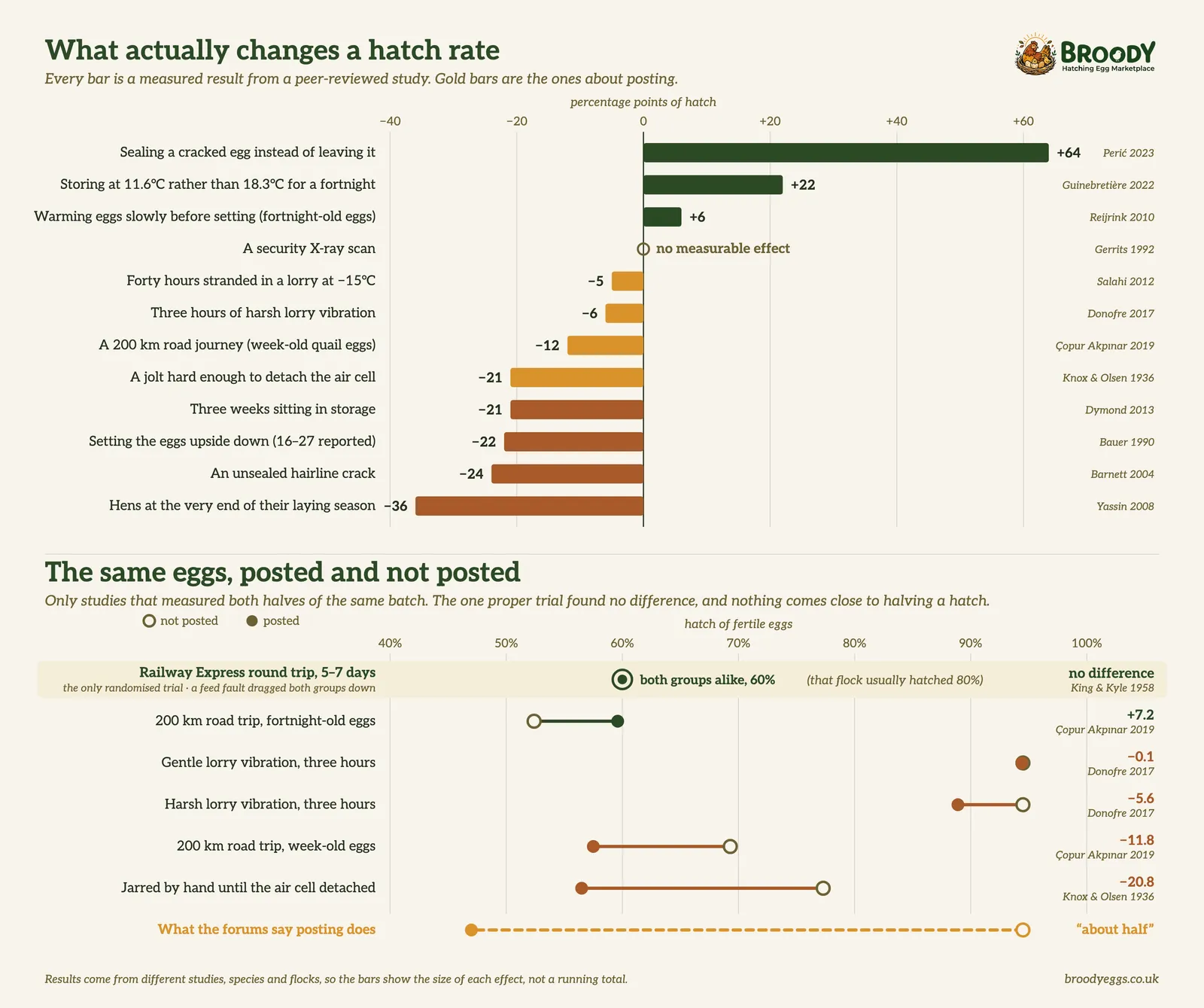
Ok, ok - no-one reads long articles nowadays! The gist is that hen age, storage and an unsealed crack move a hatch rate far more than the postie. Read on to bust those myths...!
Where fifty percent comes from
The figure is older than the internet. A 1928 catalogue from Knoxville Poultry Farms and Hatchery in Iowa, a mail-order outfit that shipped across the continent, promises to replace hatching eggs at half price for any customer who got “less than a 50% hatch”. The scan is smudged where those figures sit, so hold the exact numbers lightly; what is unmistakable is a replacement guarantee pinned to a hatch percentage, a century ago. The number has been passed down ever since. One large American hatchery’s help page states that mailed eggs “experience reduced hatchability of 60% on average” and works the arithmetic for you: a clutch that would hatch at seventy percent at home will give about forty-two percent after the post. In a 2009 BackYard Chickens thread asking for real results, one of the first replies is “50% best”. UK sellers are a little more generous: one calls fifty percent “within a normal range” and seventy-five “very good”, another UK guide calls fifty “a great success”.
None of these figures cites a dataset. Read enough forum threads and you notice that the same person reports zero out of eighteen one time and eleven out of thirteen another, and that nobody says how old the eggs were, how old the hens were, what month it was, or whether they are counting chicks against eggs set or against eggs that were fertile. That last point matters more than it sounds, so we will start there.
What a good hatch looks like before the post is involved
The biggest hatchability study ever published followed 724,750,444 eggs through three Dutch hatcheries between 2004 and 2006, roughly 37 percent of the Netherlands' hatching eggs, from 511 breeder flocks [1]. These are commercial broiler breeders, kept and incubated as well as money can manage, and their eggs never saw a postbox. Hatch of eggs set was 66 percent from 25-week-old flocks, peaked at 86 percent between 31 and 36 weeks, and had fallen to 50 percent by 65 weeks. Fifty percent, from a professional hatchery, with no post, simply because the hens were old.
Pull fertility apart from hatch and the picture sharpens. In a 2020 study, fertility was 97 percent from 31-week-old hens and 76 percent from 66-week-old hens, and of the fertile eggs, 94 percent hatched from the young flock and 84 percent from the old one [2]. A Norwegian survey of 112 flocks put the average hatch of set eggs at 75.9 percent [3]. In 1949 the US Department of Agriculture reckoned that about 30 of every 100 eggs placed in commercial incubators failed, half of them because they were never fertile [4]. A third of eggs not hatching has been normal for as long as anyone has counted.
Other species are no kinder. Game-farmed quail eggs were 83 percent fertile, and 74 percent of the fertile ones hatched when set fresh [5]. Breeder geese ran at 88 to 95 percent fertility at the start and peak of lay and collapsed to 27 to 31 percent at the end of the season [6]. A 2019 review of duck fertility cites Pekin hatchability of 78 percent in spring and 46.5 percent in summer, from hot-climate studies [7].
Two things follow. First, the age of the hens, the month, and the cockerel-to-hen ratio move a hatch rate by twenty to forty points before the eggs go anywhere; a poor hatch from posted eggs is often a poor clutch that happened to be posted. Second, always ask which denominator someone is using. "Hatch of fertile" (chicks per fertile egg) is what the science mostly reports. "Hatch of set" (chicks per egg in the incubator, empties included) is what you will get, and it is always lower. Half the arguments online are two people using different denominators.
Detached air sac is not a death sentence... the 1936 experiment that everyone quotes, but nobody has read
The foundational paper on shipping damage is by C. W. Knox and M. W. Olsen of the USDA's research station at Beltsville, Maryland, published in Poultry Science in 1936 [8]. It is the source of the hobby-world figure that a detached air cell gives "something like a 20 percent hatch rate", and it turns out to say something rather different. We read the whole thing.
The USDA had been buying hatching eggs from breeders around the United States, and noticing how many arrived with what they called tremulous air cells: the pocket at the blunt end had come loose from the shell and wobbled when the egg was turned. For numbers they went back to a batch from an earlier trial that had been railed to Chicago and back. They candled 568 of those, all about three weeks old by the time they were set. The 329 with normal air cells hatched 37.6 percent of fertile eggs. The 239 with tremulous air cells hatched 24.0 percent. The tremulous eggs were, if anything, the more fertile of the two groups, 74.0 percent against 68.7, so a loose air cell was not a sign of an infertile egg; it was a sign of a jolted one.
Then they did the experiment that matters. They took fresh, week-old eggs from their own flock and jarred them by hand, three sharp blows, until the air cell detached. The 446 jarred eggs hatched 56.5 percent of fertile against 77.3 percent for 243 untouched controls: a loss of about twenty-one points from a deliberate, violent knock. Most of the extra deaths came in the first days of incubation.
The twist is in the third part. They repeated the jarring with the eggs held small end down. Not a single air cell detached, and those eggs hatched 60.8 percent, exactly the same as the unjarred controls in that trial. Jarred large end down, every egg's air cell detached and the hatch fell to 36.9 percent. Same blow, opposite outcome, decided entirely by which end took it. The authors' recommendation was to pack hatching eggs large end up in a rigid box with room for air to circulate, and to handle them gently. Ninety years later, that is still the best advice there is.
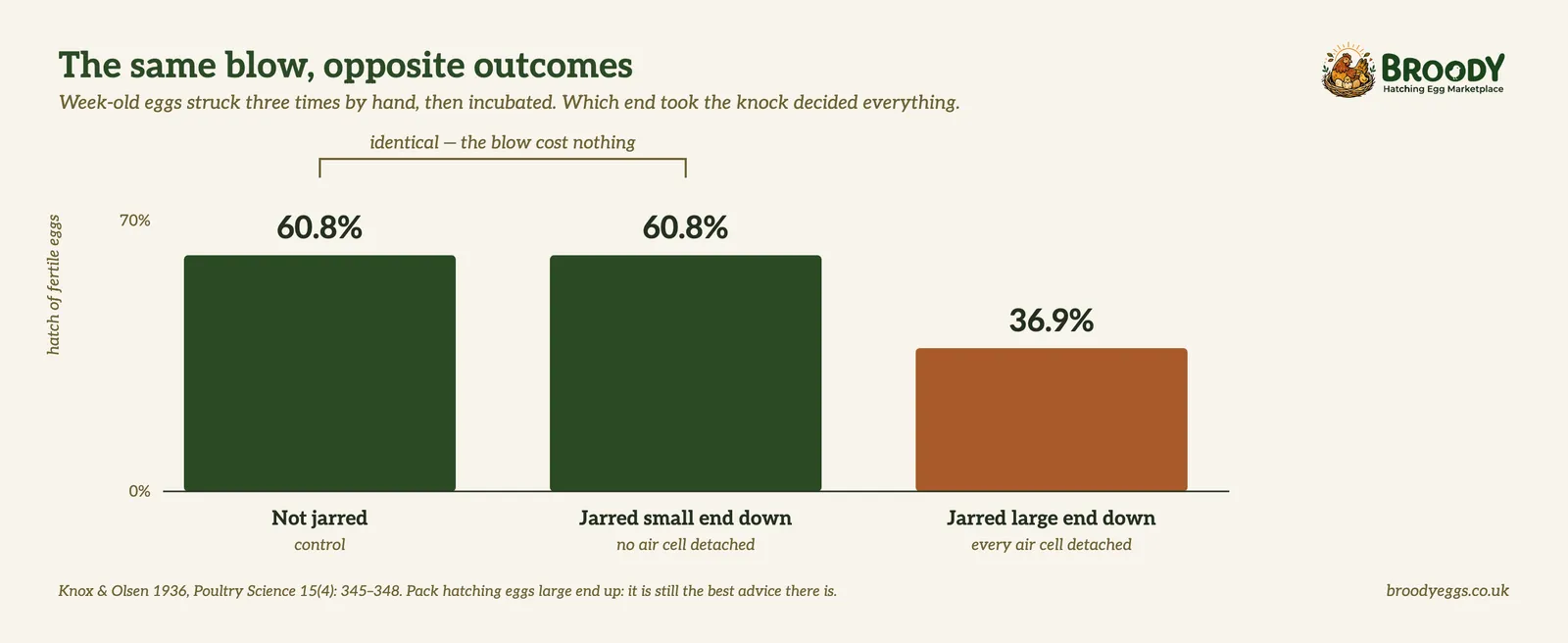
The same three blows. Held small end down, not one air cell detached and the hatch was untouched.
So a detached air cell is not a death sentence. In the fresh eggs, more than half of the jolted ones still hatched. What the loose air cell tells you is that the egg has taken a knock hard enough to disturb its contents, and the damage that matters is to the embryo, not to the air pocket you can see.
Shaking is not the same as jolting
The modern work separates two things the folklore lumps together: the steady vibration of a moving vehicle and the sharp shock of a drop or a throw.
A Brazilian team put hatching eggs on a platform that reproduced a lorry floor at 20.8 hertz, at two intensities and for one or three hours, then incubated them [9]. At the gentler setting, 2.5 metres per second squared, nothing measurable happened: 93.7 and 94.4 percent of fertile eggs hatched against 94.5 percent for the unshaken controls. At the harsher setting, 7.5 metres per second squared, which they chose to match real measurements on Brazilian roads, one hour cost two points and three hours cost five and a half, with the deaths clustered between days six and seventeen of incubation. The proportion of top-quality chicks fell from 88.8 to 80.0 percent. A Hungarian group logged the accelerations eggs experience during real handling and transport, reproduced them on a shaker for five minutes, and found hatchability only fell once the shaking reached about 10 metres per second squared, roughly the force of gravity [10]. And a 1969 Canadian study that vibrated eggs moderately every day for up to four weeks in storage found no effect on hatchability at all [11].
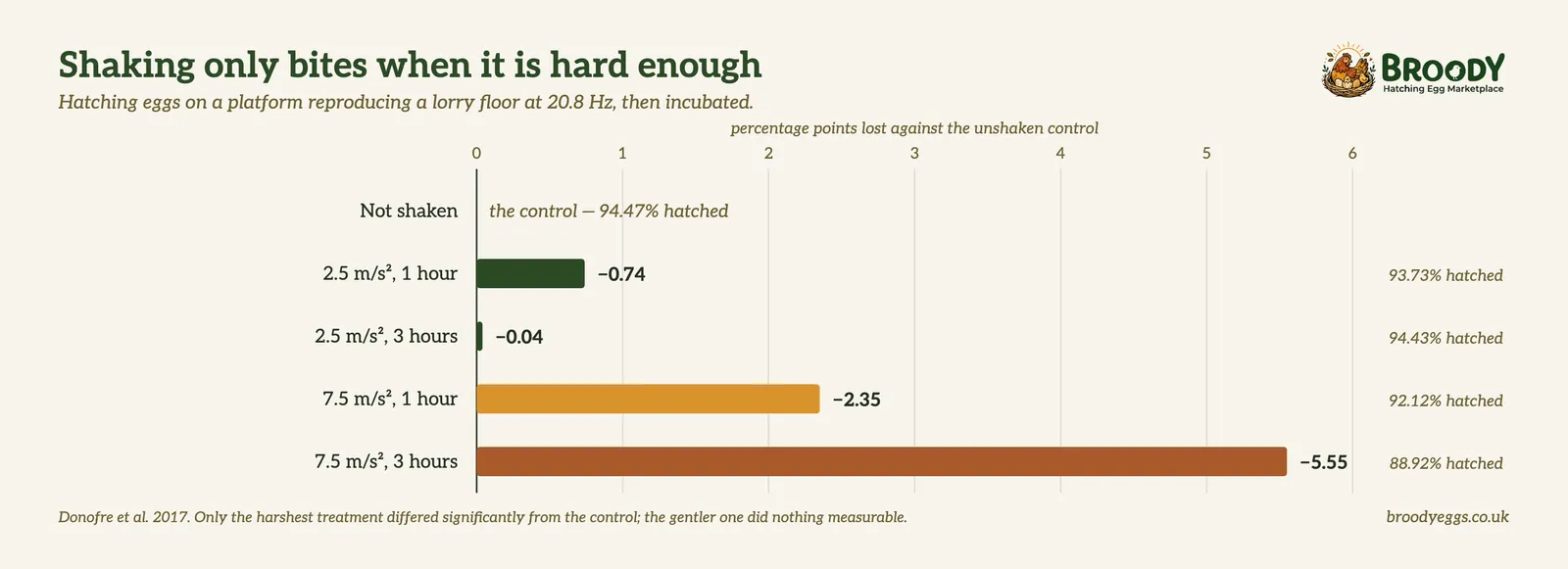
Only the harshest setting, for the longest time, made a difference anyone could measure.
Where vibration does bite, it bites the inside of the egg. Work on table eggs shaken to real lorry spectra found the thick albumen of eggs at the top of a stack had thinned by 28 percent after eight days, and the strength of the membrane around the yolk varied by 18 percent between vibration patterns [12]. Thin albumen and a weak yolk membrane are the mechanism behind the invisible losses in the shaking studies. A field study of three real lorry loads of about 90,000 eggs each found cracks after transport of 0.8 percent from young breeders and 3.3 percent from old ones, and, counter-intuitively, more vibration on tarmac than on a dirt road [13].
The only transport experiment on a species other than chickens that compares shipped against unshipped is on Japanese quail, and it delivered a surprise [14]. Two thousand eggs were stored for 7 or 14 days, and half of each group were driven 200 kilometres over secondary roads before setting. For the 7-day eggs the journey cost twelve points: 69.3 percent hatched unshipped, 57.5 percent shipped. For the 14-day eggs it went the other way: 52.4 percent unshipped, 59.6 percent shipped. The authors suggest the vibration stimulated embryos that had gone sluggish in storage. Nobody should post eggs on the strength of that, but it is a useful reminder that "posting damages eggs" is not a law of nature.
The closest anyone has come to the experiment a buyer would actually want was run in 1958, and almost nobody cites it [59]. A USDA team at Purdue took a week’s eggs from one Cornell Randombred flock, randomised them into eight lots of fifteen dozen, and sent four of those lots by Railway Express to research stations in Iowa, Missouri, Wisconsin and Michigan, which sent them straight back. The round trip took five to seven days. The other four lots waited in an egg store at about 13 degrees. Every lot went into the same incubator on the same day, at eight to fourteen days old. Shipping made no significant difference to fertility, to hatch of fertile eggs, or to hatch of eggs set, and none to any of the eleven later traits they tracked through the pullets’ laying year either. Their conclusion: “a shipping effect must be of small magnitude if it exists”. Two caveats they were honest about. A feed mix accidentally short of riboflavin and niacin dragged the whole hatch down to 60 percent of fertile against the 80 percent that flock usually managed, which could have hidden a small effect. And Railway Express in 1958 is not Royal Mail in 2026.
What a parcel actually goes through
Nobody has put a data logger inside a box of hatching eggs and sent it through Royal Mail; no peer-reviewed measurement of any UK parcel network exists at all. But the small-parcel environment has been measured elsewhere for thirty years, because the people who ship laptops want to know, and the findings travel.
The classic study strapped shock recorders to a hundred overnight parcels sent between American cities [15]. Each parcel took an average of 24 hits above ten times the force of gravity on a single one-way trip: about a third were drops, nearly half were kicks and the rest were tosses. Ninety-five percent of the drops were from below 40 centimetres, the worst from just under two metres, and 93 percent of impacts landed on an edge or a corner rather than a flat face. A 2024 Korean study using modern recorders found seven or eight significant shocks per trip, a 95th-percentile worst drop of 1.1 to 1.4 metres, and that 80 percent of hits landed on or around the bottom of the box, mostly during loading and unloading at the sorting hubs [16]. Read that alongside the 1936 experiment: the blow that detaches an air cell is the one the large end takes, so a box that is dropped on its base with the eggs pointed end down is the box that survives.
The "fragile" sticker does less than you hope. The only controlled test sent identical parcels with and without a "Fragile, Handle With Care" label and found no significant difference in the drops they received [17]. Royal Mail's compensation policy makes the label a condition of your claim, not a promise of gentler handling [18]. Write it on anyway, for the claim, and pack as if nobody will read it.
Between the hubs, the vibration is a van. Five Hungarian courier vans of the Transit and Ducato type, logged across motorways, country roads and towns, produced vertical peaks up to 4.9 times gravity with the energy concentrated around 2, 15 and 70 hertz [19]. A Hungarian hatching-egg study logged 41 real lorry journeys of two to four days and found a mean acceleration around the 10 metres per second squared mark at which the shaker trials start to bite; ten minutes at 30 hertz on a shaker cut hatch of fertile from 80.7 to 64.8 percent, and even eggs in paper trays lost four points against unshaken controls [20]. The top of a loose stack shakes hardest, which is an argument for a small, dense, well-filled box rather than a big one with eggs rattling in a corner.
Parcels are neither heated nor cooled. Thirty-six logger packages sent through three American carriers in winter and summer spent 68 percent of their transit time outside 20 to 25 degrees, with extremes of minus 15 and 39 degrees [21]. For a dormant egg that range is survivable for a day, as the heat and cold studies below show; it is the second and third day that hurt. Flying is not a worry either. A cargo hold is pressurised to roughly the altitude of a 2,400-metre mountain, and while embryos incubated for three whole weeks at that sort of altitude hatch poorly, short exposures are tolerated well [22]. The turkey eggs in the 1964 study crossed 12,000 feet in a rail car and still hatched at 67 percent [60]. A domestic UK parcel rarely leaves the ground anyway.
Packaging has been tested on table eggs, if not on hatching eggs. Polystyrene cartons inside a corrugated cardboard outer box lost 4.6 percent of eggs to breakage across runs of up to three hours on a vibration table; the same cartons in rigid plastic crates lost 12.6 percent, and 16.3 percent over the full three hours, and more than half of all breaks were on the bottom of the egg [23]. The lesson was that the design of the pack, and something soft between the egg and the outer wall, matters more than the material.
Who will actually carry them
This is where UK folklore is most out of date. Royal Mail's prohibited and restricted list does not mention eggs at all; hatching eggs fall under its perishables rule, which allows them within the UK by first class or better, packed in a strong box, labelled "PERISHABLE", and able to withstand a journey of up to 48 hours [24]. Parcelforce is the one carrier that names eggs: it requires a guaranteed next-day service as the minimum, packaging that can stand two working days in transit, and a Saturday service for anything posted on a Friday [25]. Evri lists "live animals and eggs" as prohibited outright [26], and DPD prohibits "any living organism of any type", which a fertile egg arguably is [27]. A seller using the cheapest courier may be sending your eggs uninsured and against the carrier's own terms.
The other thing to know is that "first class" is not the same as "next day". In 2024/25 Royal Mail delivered 76.5 percent of first class post the next working day against a target of 93 percent, and Ofcom fined it 21 million pounds for the shortfall [28]. Nearly a quarter of first class items take longer. For eggs, where every day costs hatch and a weekend in a sorting office costs more, a tracked 24-hour or guaranteed next-day service is the difference between a two-day-old clutch and a five-day-old one.
The quiet killer is age
Here is the number that explains most bad hatches from posted eggs, and it has nothing to do with the postie. In the Dutch dataset, every day an egg waited before setting cost 0.2 percentage points of hatch up to day seven, and 0.5 points a day from day seven to fourteen [1]. A British study from 1980 found a steeper slope, 1.2 points per day up to eight days, when eggs of mixed ages were set together [29]. Stored at 18 degrees, eggs hatched 94.4 percent of fertile at five days, 91.5 at ten and 87.9 at fifteen [30]. Held cool at 11.5 degrees, hatch of set eggs was 88.2 percent after four days and 58.4 percent after fourteen [31]. Three weeks in cool storage took hatchability from 92 to 71 percent [32]. The reviews agree that the decline sets in after about a week and steepens after that [33], and that eggs from older hens are the fragile ones [34].
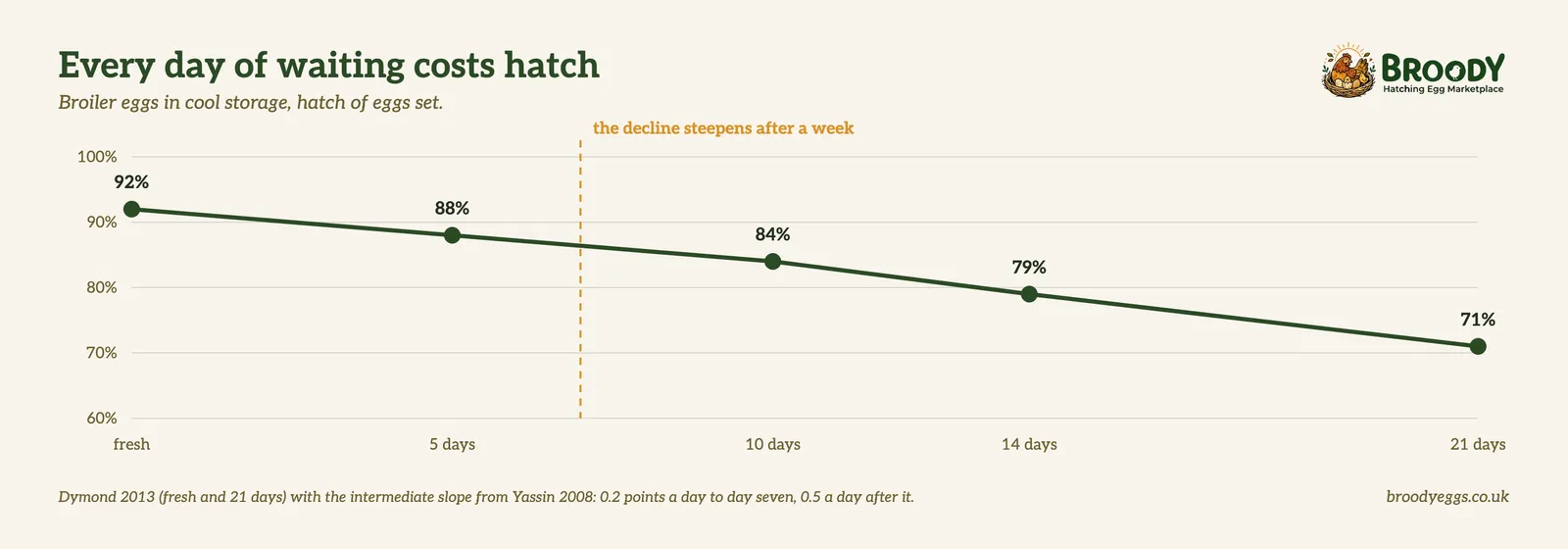
The cost of the calendar, which is usually larger than the cost of the post.
Now count the days in a typical order. The seller collects eggs over three or four days to make up a clutch, posts on Monday, the box arrives Tuesday, you rest it until Wednesday. The youngest egg is three days old when it goes in and the oldest a week. That is fine. But collect for a week, hold the box over a weekend, add a bank holiday and a cautious two-day rest, and the oldest eggs are pushing a fortnight before they warm up. At that point the studies above say you have already lost ten to twenty points, and the post gets the blame.
This is also why the 1936 shipped eggs did so badly. They were three weeks old when they were set, and three weeks of storage would have cost them heavily before any journey. The detached air cells took a further thirteen points on top of that.
The practical reading is simple. Ask the seller when the eggs were laid. Good breeders collect for no more than three or four days and post the same day or the next. On Broody the listing shows the clutch and the postage service, and next-day post is the single biggest advantage a UK buyer has over the American forums where the fifty percent legend grew up, because there a hatching-egg parcel commonly takes two to five days.
Heat and cold: hours are fine, days are not
An egg is a paused embryo, and the pause is temperature. Below what physiologists call physiological zero, development stops; above it, the embryo starts growing, slowly and badly, in a box with no incubator. The threshold was put at 20.5 degrees in 1902 and pushed up to about 27 degrees by a 1944 study that watched the blastoderm barely enlarge at temperatures several degrees above that old figure [35]. A warm British summer day in a van does not reach it for long. A parcel left in a sunny porch for two days does.
The heat studies bear this out. Eggs exposed to 35 degrees for up to twelve hours before storage hatched no worse than eggs that were not [36]. But eggs stored for fourteen days at 23.9 degrees had the highest early mortality and the greatest weight loss of any group in a 1995 trial [37], and in a 2022 French study, fourteen days at 18.3 degrees hatched 62 percent against 84 percent at 11.6 degrees for eggs from a young flock [38]. Cool is good. Cool and brief is better.
Cold gets more blame than it deserves. The best evidence comes from an accident: one January, a lorry carrying 72,000 hatching eggs was stranded for forty hours in Iranian weather of about minus fifteen degrees [39]. The hatchery measured the temperature inside eggs on arrival, which ranged from minus 1.2 to 6 degrees, warmed them gently and set them. The unchilled controls hatched 92.6 percent of fertile; the chilled eggs hatched between 87.3 and 89.9 percent depending on how cold they had got, with slightly more malpositions and culls. Nothing froze, even at minus 1.2 degrees inside the egg. Fertility was unchanged. A cold night in a sorting office is not going to kill a clutch. Ice will, and no study we could find tells you exactly when that happens for a chicken egg.
The twenty-four-hour rest, and where it came from
Every guide says it: when posted eggs arrive, stand them pointed end down for twenty-four hours before setting. Some say twelve, some say forty-eight, and a few say the air cell will "re-attach" if you do. We traced the rule back as far as it goes, and it turns out to be older than any experiment on the subject.
It is in a United States Department of Agriculture Farmers' Bulletin from 1914 on shipping eggs by parcel post [40]. The bulletin tells the recipient of hatching eggs to stand them on the small end in bran for a day, "in order that the germs may thoroughly settle". The same words are repeated in the 1917 edition, alongside the postal rule of the time that hatching eggs be individually wrapped in wood-wool, labelled, and carried outside the mail sacks [41]. No trial is cited. It was sensible advice from a government marketing officer, and it has been repeated for 112 years.
The science since then supports the rest, but not for the reason the folklore gives. A 2010 Dutch study warmed eggs from storage to incubation temperature over twenty-four hours instead of four [42]. For eggs stored thirteen days the slow warm-up cut deaths in the first two days of incubation by 4.4 points and raised hatchability by 5.7 points. For eggs stored four days it made no difference at all. A run of 1950s experiments found the same thing in reverse: leaving eggs overnight at room temperature before they went into cold storage improved their hatch [43]. A hatchery-equipment manufacturer's technical note recommends at least twelve hours' rest after transport and warns that setting immediately increases early embryonic mortality.
So the rest is a warm-up, and a gentle one at that: it lets a chilled egg come up to room temperature without condensation and gives an embryo that has been dormant for a week a slower start. What it does not do is repair anything. No study has ever shown a detached air cell reattaching, and in the 1936 experiment the eggs that hatched worst were damaged at the moment of the blow, not at setting. A rest of twelve to twenty-four hours is right. Three days is not, because every one of those days costs the 0.2 to 1.2 points above.
Pointed end down is also right, and here the folklore and the physics agree: it is the orientation that produced no detached air cells in the jarring experiment [8], and it is how the industry packs eggs for air freight. One oddity worth knowing: for storage beyond a week, several studies found that eggs stored the other way up, small end up, actually hatched better, because the yolk stays centred [44] [11]. That is a storage trick for breeders holding eggs before a big set, not a reason to rest posted eggs upside down. Once incubation starts the large end must be up: setting eggs small end up cut hatch of fertile by 16 to 27 percent in a 1990 British trial [45].
"Don't turn them for the first three days"
This one is repeated for posted eggs with damaged air cells, on the theory that stillness lets the cell "stabilise". No study has tested it on damaged eggs, so the honest answer is that nobody knows. What the turning research does say is uncomfortable for the advice.
Two classic studies found the critical window for turning to be days three or four to seven of incubation: eggs turned only during that window hatched as well as eggs turned throughout, and eggs turned only afterwards hatched no better than eggs never turned [46] [47]. On that reading a three-day pause costs little. But a 2004 study that switched turning off in two-day blocks found days nought to two the single most damaging period to skip, with more embryos dying and more chicks malpositioned head-in-the-small-end, especially from older flocks [48]. The first week is when turning matters most, and the optimum is a lot of it: 96 turns a day in the definitive 1961 trial, with nil or few turns giving very poor hatches [49].
Our reading: if you want to hold damaged-air-cell eggs still, keep it to the first day and then turn as normal. A week of stillness has no evidence behind it and a fair amount against.
Cracks, X-rays and the other stories
Hairline cracks
These matter more than the folklore suggests, and they are more fixable. Hairline-cracked eggs hatched 50.5 percent against 74.4 for intact eggs in one study [50], and embryonic mortality was 51 percent for hairline cracks, 37 percent for star cracks and 13 percent for intact shells in another [51]. The damage is done by water loss through the crack. Seal it and the loss largely disappears: cracked eggs sealed with surgical tape hatched 89 to 91 percent of fertile against 21 to 24 percent unsealed, no different from intact controls [52], and a 2025 comparison found clear nail polish improved hatchability and chick weight, with beeswax matching intact eggs for water loss [53]. The hobby rule, wax or clear nail varnish over a hairline crack, is one of the few that comes out of the literature looking better than it went in. Candle the box on arrival, seal the cracks the same day, and set them with the rest.
X-ray scanners
The advice to write "do not X-ray" on the box has no support, and the numbers are not close. Parcel and cabin-baggage scanners are cabinet X-ray systems, which the US Food and Drug Administration says deliver a dose of one millirad or less to the object scanned [54]; a US government measurement of airport equipment found the harsher hold-baggage CT scanners deliver up to about 1.6 millisieverts per pass [55]. Against that, hatching eggs deliberately irradiated with 4 to 17 rad hatched normally and on time [56]; roughly 22,000 broiler eggs given up to 1.2 gray of gamma radiation before incubation showed no difference in hatchability or chick weight [57]; and harm only appeared at 6 gray, where hatch fell from 70 to 29 percent [58]. A cabinet scan is around a hundred thousand times below the dose shown to do nothing, and even a pass through the worst hold-baggage scanner is several hundred times below it. An American breeder who posts hatching eggs reports the same hatch with and without the label. Whether a domestic UK parcel is X-rayed at all is a question for the carrier, not for the embryo.
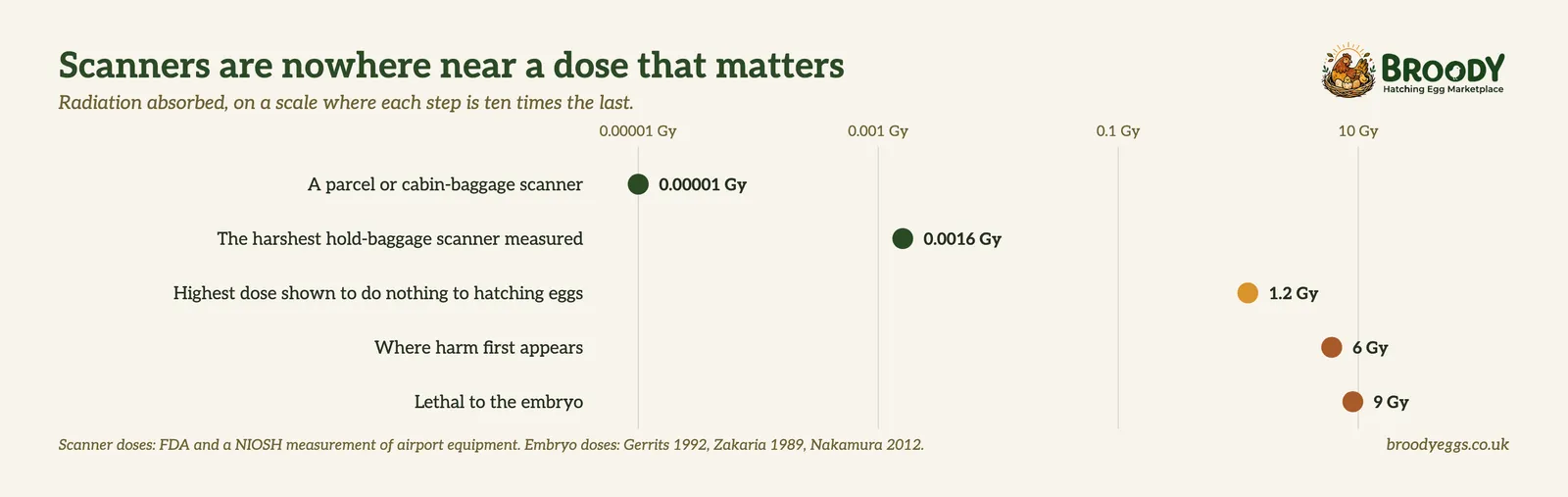
Scanner doses sit tens of thousands of times below a dose already shown to do nothing.
Saddle air cells
The misshapen, tilted air cell that hobbyists call a saddle has never been studied as a category. The only air-cell data are for fully detached cells, and those hatched at more than half the normal rate when the eggs were fresh [8]. Treat a saddle as a warning that the egg has been knocked, set it, and see.
Bubble wrap
The one packing comparison run on hatching eggs that were actually shipped is a turkey study from 1964 [60]. Six hundred eggs travelled by rail from Washington State to Arizona and back, ten days in transit; half sat in ordinary fibre flats and half were sealed inside a plastic bag first. The sealed eggs hatched 67 percent of fertile against 48 percent for the rest, nineteen points from nothing but a bag, and the gap widened the longer the eggs had waited before they travelled. Beyond that, the table-egg work above found the design of the pack mattered more than the material [23]. What the evidence supports is the principle: sharp shocks are the damaging kind, the blunt end must not take the blow, and an egg's position in a stack changes how much vibration it receives [12]. Individually wrapped, snug but not rigid, pointed end down, in a box inside a box with something soft between them, is what the 1914 postal rules required and what good sellers still do. Our guide to how hatching eggs are posted safely has the packing checklist.
So what should you actually expect?
Put the studies together and the journey itself costs a posted clutch somewhere between nothing measurable and fifteen points: nothing at all in the one controlled trial, about five from the vibration of an ordinary trip, more if the box was dropped, and a further chunk if the air cells detached. What turns that into fifty percent is everything else stacked on top: eggs collected over a week and posted on a Friday, hens at the end of a long season, a July heatwave, an incubator whose thermometer has never been checked, and a buyer counting chicks against every egg in the box rather than the fertile ones.
A fresh clutch from young birds, posted next-day within the UK, rested overnight and set in a calibrated incubator has no business hatching at fifty percent. Our reading of the evidence is that seventy percent of fertile is a fair expectation, and eighty is not unusual. Equally, a fortnight-old clutch that has been round the houses can hatch at thirty and it is nobody's fault but the calendar's. Our plain-English guide to hatch rates turns this into a checklist.
The honest gap in all of this is that nobody has measured a UK parcel network, and nobody has repeated the 1958 experiment with a modern courier, a modern flock and a feed ration that was not accidentally short of two vitamins. The 1936 eggs had no unshipped control and were three weeks old. The 1964 turkey eggs were all shipped, so they tell you about packing rather than about posting. And every hobby figure we traced was a recollection.
We would like to change that. Every Broody buyer is asked, with their review, how many chicks hatched, how many eggs were empty, how they incubated, how long the eggs rested before setting, and how they were packed; the clutch size and the postage service are taken from the order itself. Individually those reports tell a seller how their eggs are travelling. Collectively, once there are enough of them to be honest about, they are the first dataset of its kind for posted eggs in Britain, and we intend to publish what they say. If you have hatched with us, fill the report in, including the bad ones. Especially the bad ones.
The short version
A third of eggs failing to hatch is normal even in a commercial hatchery with no post involved [4]. Hen age, season and cockerel ratio move hatch rates by twenty to forty points on their own [1].
The one controlled test of shipping, run in 1958, found no significant effect on hatch at all [59].
Steady vibration at ordinary intensities does little; sharp shocks do the damage, and which end of the egg takes the knock decides whether the air cell detaches [8].
A detached air cell is not a dead egg. Fresh, jolted eggs still hatched 56.5 percent of fertile against 77.3 for controls [8].
Age costs 0.2 to 1.2 points a day, steepening after a week [1] [29]. Ask when the eggs were laid; buy from sellers who post fresh.
Heat for hours is tolerated; heat for days is not. Cold to just below freezing inside the egg cost a few points, not the clutch [39].
Rest posted eggs twelve to twenty-four hours, pointed end down, as a warm-up. It does not repair anything, and longer costs hatch.
Turn from the start. A three-day pause has no evidence for it and some against [48].
Seal hairline cracks with clear nail varnish or wax the day they arrive; it works [52].
Forget the X-ray label [56].
Use a tracked next-day service and avoid Friday posting. Nearly a quarter of first class post misses next day [28], and Evri will not knowingly carry eggs at all.
Count against fertile eggs, and expect seventy percent or better from a fresh clutch posted next-day.
Sources
In the order they first appear. Peer-reviewed studies link to the publisher's record; official documents are marked as such.
Yassin H, Velthuis AGJ, Boerjan M, van Riel J, Huirne RBM (2008). Field study on broiler eggs hatchability. Poultry Science 87(11): 2408–2417. doi:10.3382/ps.2007-00515
Nasri H, van den Brand H, Najar T, Bouzouaia M (2020). Interactions between egg storage duration and breeder age on selected egg quality, hatching results, and chicken quality. Animals 10(10): 1719. doi:10.3390/ani10101719
Heier BT, Jarp J (2001). An epidemiological study of the hatchability in broiler breeder flocks. Poultry Science 80(8): 1132–1138. doi:10.1093/ps/80.8.1132
Olsen MW, Haynes SK (1949). Egg characteristics which influence hatchability. Poultry Science 28: 198–201. doi:10.3382/ps.0280198
González-Redondo P, Robustillo P, Caravaca FP (2023). Effects of long-term storage on hatchability and incubation length of game farmed quail eggs. Animals 13(13): 2184. doi:10.3390/ani13132184
Aslan E, Onbaşılar EE, Yalçın S (2026). Effects of genotype and laying stage on egg traits and hatchability in breeder geese. Veterinary Medicine and Science 12(2): e70889. doi:10.1002/vms3.70889
Abd El-Hack ME, Hurtado CM, Toro DM, Alagawany M, Abdelfattah EM, Elnesr SS (2019). Fertility and hatchability in duck eggs. World's Poultry Science Journal 75(4): 599–608. doi:10.1017/S0043933919000060
Knox CW, Olsen MW (1936). The effect of tremulous air cells upon the hatchability of eggs. Poultry Science 15(4): 345–348. doi:10.3382/ps.0150345
Donofre AC, da Silva IJO, Nazareno AC, Ferreira IEP (2017). Mechanical vibrations in the transport of hatching eggs and the losses caused in the hatch and quality of broiler chicks. Journal of Agricultural Engineering 48(1): 36–41. doi:10.4081/jae.2017.593
Torma T, Kovácsné Gaál K (2024). Induced and field mechanical effects on the hatchability of broiler breeder hatching eggs. European Poultry Science 88: 1–10. doi:10.1399/eps.2024.397
Proudfoot FG (1969). Effect of packing orientation, daily positional change and vibration on the hatchability of chicken eggs stored up to four weeks. Canadian Journal of Animal Science 49(1): 29–35. doi:10.4141/cjas69-005
Berardinelli A, Donati V, Giunchi A, Guarnieri A, Ragni L (2003). Effects of transport vibrations on quality indices of shell eggs. Biosystems Engineering 86(4): 495–502. doi:10.1016/j.biosystemseng.2003.08.017
Nazareno AC, da Silva IJO, Vieira AMC, Vieira FMC, Miranda KOS (2014). Transporte de ovos férteis: influência das idades das matrizes, tempos de estocagem e das estradas. Revista Brasileira de Engenharia Agrícola e Ambiental 18(3): 338–343. doi:10.1590/S1415-43662014000300014
Çopur Akpınar G, Günenç A (2019). Effects of transportation and storage duration of Japanese quail eggs on hatchability. South African Journal of Animal Science 49(2). doi:10.4314/sajas.v49i2.6
Singh SP, Cheema A (1996). Measurement and analysis of the overnight small package shipping environment for Federal Express and United Parcel Service. Journal of Testing and Evaluation 24(4): 205–211. doi:10.1520/JTE11442J
Kim S, Horvath L, Lee S (2024). Measurement and analysis of the shock and drop levels experienced by small and medium packages in the Korean parcel delivery system. Applied Sciences 14(10): 3990. doi:10.3390/app14103990
Singh SP, Burgess G, Singh J (2004). Measurement and analysis of small and light weight parcel shipping environment. Journal of Testing and Evaluation 32(5): 351–357. doi:10.1520/JTE12303
Royal Mail. Retail compensation policy for damage and part loss (official policy page). royalmail.com
Böröcz P (2018). Averaged vibration levels during courier parcel delivery service in small truck in Hungary. FME Transactions 46(3): 211–217. doi:10.5937/fmet1802211b
Torma TÁ, Kovácsné Gaál K (2024). Measuring the mechanical effects of egg transport in field and modelled conditions. Chemical Engineering Transactions 114: 979–984. cetjournal.it (PDF)
Chowdhury DA, Jeong MS, Vyas L, et al. (2023). Evaluation of temperature excursions from USP <659> recommendations during mail transit. Journal of the American Pharmacists Association 63(3): 847–852. doi:10.1016/j.japh.2023.02.002
Tengerdy RP, Fitch JW, Moreng RE (1969). Hatchability of chicken embryos under simulated high altitude conditions. Poultry Science 48(2): 751–753. doi:10.3382/ps.0480751
Seydim AC, Dawson PL (1999). Packaging effects on shell egg breakage rates during simulated transportation. Poultry Science 78(1): 148–151. doi:10.1093/ps/78.1.148
Royal Mail. Prohibited and restricted items: personal customer guidelines (official help page; the Post Office publishes the same list). help.royalmail.com
Parcelforce Worldwide. Prohibitions and restrictions (official page). parcelforce.com
Evri. What you can and can't send by courier (official page). evri.com
DPD UK. Prohibited goods (official page). dpd.co.uk
Ofcom (2025). Investigation into Royal Mail's quality of service performance in 2024/25, decision of 15 October 2025. ofcom.org.uk
Kirk S, Emmans GC, McDonald R, Arnot D (1980). Factors affecting the hatchability of eggs from broiler breeders. British Poultry Science 21(1): 37–53. doi:10.1080/00071668008416633
Okasha HM, El-Gendi GM, Eid KM (2023). The effect of storage periods and SPIDES on embryonic mortality, hatching characteristics, and quality of newly hatched chicks in broiler eggs. Tropical Animal Health and Production 55(2): 133. doi:10.1007/s11250-023-03547-x
Fasenko GM, Robinson FE, Whelan AI, Kremeniuk KM, Walker JA (2001). Prestorage incubation of long-term stored broiler breeder eggs: 1. Effects on hatchability. Poultry Science 80(10): 1406–1411. doi:10.1093/ps/80.10.1406
Dymond J, Vinyard B, Nicholson AD, French NA, Bakst MR (2013). Short periods of incubation during egg storage increase hatchability and chick quality in long-stored broiler eggs. Poultry Science 92(11): 2977–2987. doi:10.3382/ps.2012-02816
Reijrink IAM, Meijerhof R, Kemp B, van den Brand H (2008). The chicken embryo and its micro environment during egg storage and early incubation. World's Poultry Science Journal 64(4): 581–598. doi:10.1017/S0043933908000214
Özlü S, Elibol O, Brake J (2018). Effect of storage temperature fluctuation on embryonic development and mortality, and hatchability of broiler hatching eggs. Poultry Science 97(11): 3878–3883. doi:10.3382/ps/pey253
Funk EM, Biellier HV (1944). The minimum temperature for embryonic development in the domestic fowl. Poultry Science 23(6): 538–540. doi:10.3382/ps.0230538 (the 1902 figure is Edwards CL, American Journal of Physiology 6: 351–397, doi:10.1152/ajplegacy.1902.6.6.351)
Bowling JA, Howarth B (1981). The effects of exposing broiler breeder eggs to high temperature before storage on hatchability and subsequent performance of chicks. Poultry Science 60(10): 2333–2336. doi:10.3382/ps.0602333
Walsh TJ, Rizk RE, Brake J (1995). Effects of temperature and carbon dioxide on albumen characteristics, weight loss, and early embryonic mortality of long stored hatching eggs. Poultry Science 74(9): 1403–1410. doi:10.3382/ps.0741403
Guinebretière M, Puterflam J, Keïta A, et al. (2022). Storage temperature or thermal treatments during long egg storage duration influences hatching performance and chick quality. Frontiers in Physiology 13: 852733. doi:10.3389/fphys.2022.852733
Salahi A, Moosanezhad Khabisi M, Pakdel A, Baghbanzadeh A (2012). Effects of cold stress during transportation on hatchability and chick quality of broiler breeder eggs. Turkish Journal of Veterinary and Animal Sciences 36(2): 159–167. doi:10.3906/vet-1101-750
Flohr LB (1914). Shipping eggs by parcel post. USDA Farmers' Bulletin 594. archive.org/details/CAT87202397
Flohr LB (1917). Marketing eggs by parcel post. USDA Farmers' Bulletin 830. archive.org/details/CAT87202839
Reijrink IAM, Berghmans D, Meijerhof R, Kemp B, van den Brand H (2010). Influence of egg storage time and preincubation warming profile on embryonic development, hatchability, and chick quality. Poultry Science 89(6): 1225–1238. doi:10.3382/ps.2009-00182
Becker WA, Bearse GE (1958). Pre-incubation warming and hatchability of chicken eggs. Poultry Science 37(4): 944–948. doi:10.3382/ps.0370944
Elibol O, Brake J (2008). Effect of egg position during three and fourteen days of storage and turning frequency during subsequent incubation on hatchability of broiler hatching eggs. Poultry Science 87(6): 1237–1241. doi:10.3382/ps.2007-00469
Bauer F, Tullett SG, Wilson HR (1990). Effects of setting eggs small end up on hatchability and posthatching performance of broilers. British Poultry Science 31(4): 715–724. doi:10.1080/00071669008417302
New DAT (1957). A critical period for the turning of hens' eggs. Journal of Embryology and Experimental Morphology 5(3): 293–299. doi:10.1242/dev.5.3.293
Deeming DC (1989). Characteristics of unturned eggs: critical period, retarded embryonic growth and poor albumen utilisation. British Poultry Science 30(2): 239–249. doi:10.1080/00071668908417144
Elibol O, Brake J (2004). Identification of critical periods for turning broiler hatching eggs during incubation. British Poultry Science 45(5): 631–637. doi:10.1080/00071660400006271
Robertson IS (1961). The influence of turning on the hatchability of hens' eggs. I. The effect of rate of turning on hatchability. Journal of Agricultural Science 57(1): 49–56. doi:10.1017/S0021859600050000
Barnett DM, Kumpula BL, Petryk RL, Robinson NA, Renema RA, Robinson FE (2004). Hatchability and early chick growth potential of broiler breeder eggs with hairline cracks. Journal of Applied Poultry Research 13(1): 65–70. doi:10.1093/japr/13.1.65
Khabisi MM, Salahi A, Mousavi SN (2012). The influence of egg shell crack types on hatchability and chick quality. Turkish Journal of Veterinary and Animal Sciences 36(3): 289–295. doi:10.3906/vet-1103-20
Perić L, Mitraković M, Vekić M, et al. (2023). Improving the incubation results by sealing the eggshell of cracked hatching eggs with surgical tape. Poultry Science 102(3): 102466. doi:10.1016/j.psj.2022.102466
Yeom GL, Lee HN, Kim YB, et al. (2025). Effects of different sealing materials for cracked hatching eggs on hatchability, hatching characteristics, and early growth performance of broiler chicks. Tropical Animal Health and Production 57(8): 466. doi:10.1007/s11250-025-04716-w
US Food and Drug Administration. Frequently asked questions on cabinet X-ray systems (regulator page). fda.gov
Achutan C, Mueller C (2008). Evaluation of radiation exposure to TSA baggage screeners. NIOSH Health Hazard Evaluation Report HETA 2003-0206-3067. cdc.gov (PDF)
Gerrits AR, Dijk DJ (1992). Effect of X-ray irradiation of hatching eggs on hatching time, hatchability and broiler weight. Archiv für Geflügelkunde 56(4): 179–181. doi:10.1016/S0003-9098(25)01204-4
Zakaria AH (1989). Effect of low doses of gamma irradiation before incubation on hatchability and body weight of broiler chickens hatched under commercial conditions. Poultry Science 68(8): 1150–1152. doi:10.3382/ps.0681150
Nakamura Y, Usui F, Miyahara D, et al. (2012). X-irradiation removes endogenous primordial germ cells and increases germline transmission of donor PGCs in chimeric chickens. Journal of Reproduction and Development 58(4): 432–437. doi:10.1262/jrd.2012-045
King SC, Kyle WH (1958). Effect of shipment of hatching eggs on future performance. Poultry Science 37(5): 1175–1177. doi:10.3382/ps.0371175
Becker WA, Spencer JV, Swartwood JL (1964). Hatchability of turkey eggs shipped in plastic bags. Poultry Science 43(6): 1539–1541. doi:10.3382/ps.0431539
Also consulted: Winter AR and Funk EM, Poultry Science and Practice (Lippincott, 1946), on tremulous air cells in long-distance shipments; the 1928 Knoxville Poultry Farms and Hatchery catalogue digitised by the USDA National Agricultural Library; the Pas Reform technical note "Hatching egg transport" (2012); the USPOULTRY/Aviagen Global Guide to Best Practices in Air Transport of Hatching Eggs (2019); and the hobby and hatchery pages quoted in the opening section, which are named there rather than linked.
Comments
No comments yet - start the conversation.