

"Rest them for 24 hours, so the air cells can re-attach..."
You've likely heard this before... it's fairly common advice, nearly every breeder says the same. But the science might suprise you - the advice to rest is sound, but the why is not.
The simple version is: When your hatching eggs arrive, stand them pointy end down and leave them 12 to 24 hours to let them reach room temperature before they go in.
Read on to satisfy your curiosity...
What the post does to an egg
Whether it goes Royal Mail Tracked 24 or Tracked 48, a posted egg spends a night or two in sorting offices and vans. Texas A&M's incubation guide warns that eggs handled roughly, or let get too hot or too cold in transit, hatch less well.
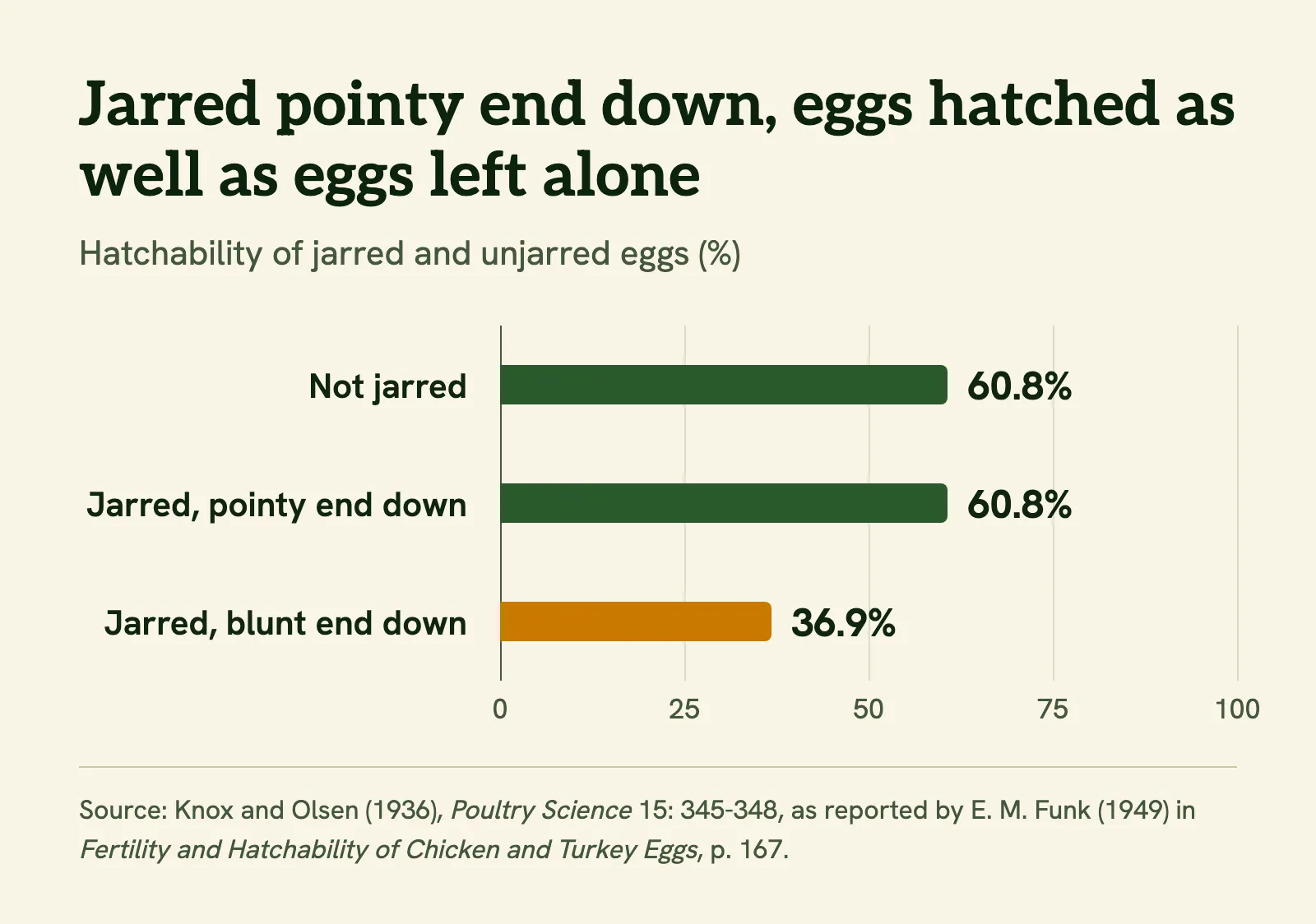
The jolting matters, and so does which way up the egg is when it happens. In the 1930s Charles Knox and Marlow Olsen, at the US Department of Agriculture's research centre in Beltsville, noticed that eggs sent in by breeders often arrived with loose air cells and hatched worse. So they jarred eggs on purpose. As the poultry scientist E. M. Funk summarised their results in 1949, eggs jarred standing pointy end down hatched exactly as well as eggs left alone, 60.8% each, while eggs jarred blunt end down hatched 36.9%.
A Hungarian team saw the same sensitivity in 2024 with a vibration table: five minutes of shaking before incubation was enough to lower hatchability significantly.
None of this means the post ruins eggs. Funk wrote that millions of hatching eggs travelled hundreds of miles every year without serious harm, and that shipped eggs sometimes hatched better than local ones, though shipping did generally lower hatchability. Good packing and pointy-end-down eggs are the best protection we know of. A rest of 12 to 24 hours at your end is cheap insurance on top.
We've been through the rest of the evidence, from parcel drop tests to what each extra day of storage costs a hatch which you can read about in our deep dive into what the science actually says about posted hatch rates.
Does a loose air cell re-attach?
Every egg has an air cell at the blunt end, a pocket of air between the two membranes just under the shell. A rough journey can tear it free, so that it slides about when you tilt the egg. The US Department of Agriculture's egg graders call that a free air cell, and a ruptured one that has thrown off small separate bubbles, usually just under the main air cell, a bubbly air cell. "Saddled" air cells, bent like a saddle, are a hobby term rather than a grading one; the Yorkshire poultry keeper Neil Armitage puts them down to membranes that didn't form properly in the hen.
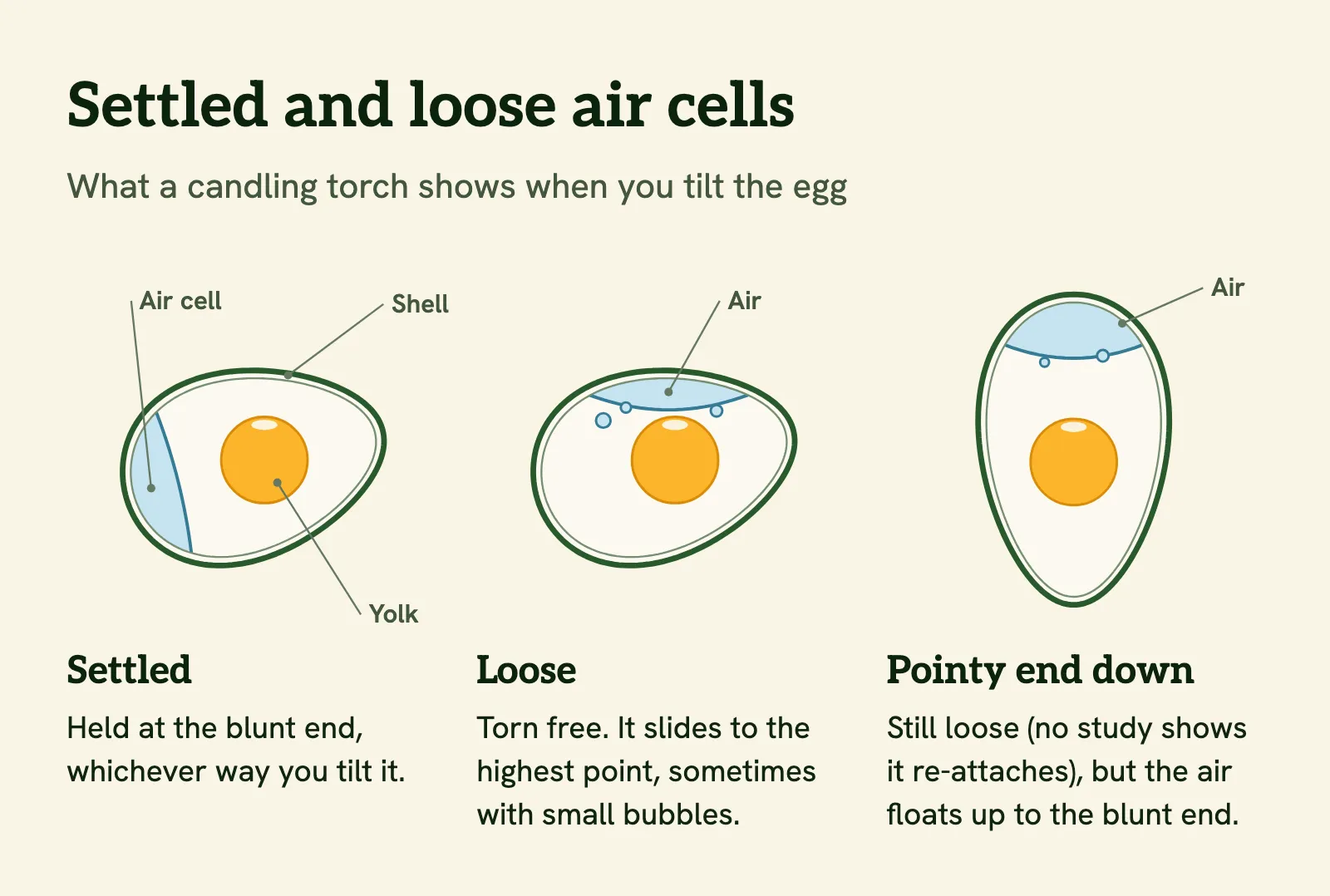
We couldn't find a single study showing that a rest lets a loose air cell re-attach, and Armitage puts it plainly on his site, Cluckin: air cells never heal. Funk's 1949 advice wasn't to wait for them to recover, either, but to candle the eggs and leave out the ones with tremulous air cells.
So use the rest as a chance to look, not as a cure. If an air cell wanders when you candle an egg, it can still hatch, just less often. Keep it pointy end down: a loose air cell always floats to the highest point, so this keeps the air at the blunt end, where the chick will need it.
The real reasons to wait
The first is temperature. In winter a parcel can arrive properly cold, and a cold egg put straight into a warm, humid incubator sweats. Aviagen's dew point table, written for commercial hatcheries, shows that air at incubation temperature and 50% humidity condenses on any shell colder than about 25°C. Aviagen, Texas A&M and Mississippi State all warn that this film of water helps bacteria into the egg and costs you chicks. One modern American test found sweating didn't let more Salmonella into table eggs, so the size of the risk is argued over, but it costs nothing to avoid.
A room-temperature egg is past that danger in minutes: in a 1950s study, turkey eggs starting at 21°C reached 27°C inside within 10 minutes of going into an incubator, and eggs starting at 13°C took three times as long. Whether the jolt of heat harms the embryo itself is less clear. Dutch researchers found that warming eggs over 24 hours rather than 4 made no difference to eggs four days old, though it lifted the hatch of eggs stored for 13 days by 5.7%.
The second reason is older, and it was never about the air cell. In 1914 the US Department of Agriculture told people to stand posted eggs small end down for 24 hours "in order that the germs may thoroughly settle", the germ being the embryo, the pale disc on top of the yolk. In 1943 Walter Landauer and Lisbeth Baumann shook eggs and, as Funk reported, found that shaking caused rumplessness (embryos with no tail), more so when the eggs were shaken blunt end down, along with other deformities, in the strain of White Leghorns they used. Resting the eggs for 24 or 48 hours after the shaking made rumplessness less common. It's one old experiment, but the only one we found that tested a rest after shaking, and it's a second reason for pointy end down.
How long: 12 to 24 hours
Nobody has trialled 6 hours against 12 and 24 for posted eggs, so we've gone with the weight of what exists. At the short end, UK sellers say overnight (Durham Hens), and 12 hours, about a night, is already longer than a hatchery takes to warm eggs: 6 to 8 hours in a well-ventilated pre-warming room. At the long end, twenty-four hours is the rest the USDA recommended in 1914, and the shorter of the two rests Funk reports Landauer and Baumann testing. The breeding company Aviagen tells hatcheries to let eggs rest 24 to 48 hours after transport, then warms them separately, and its 2009 hatchery guide is blunter still: don't set eggs on arrival, "allow them to settle in the egg store for 24 hours". East Sussex Smallholders, writing about duck eggs, say 24 hours too. So 12 hours covers the warming, and the full day gives a jolted egg the longer rest the old trials used. If the box has clearly had a rough trip, or turns up cold, lean towards the full day.
The biggest record we found points the other way. From 1987 to 1990 a hatchery on Okinawa set most of 5.4 million broiler eggs soon after a 35-hour journey by van and cargo ship, and hatched 80 to 88% of them, about what its researchers expected of unshipped eggs. There was no unshipped group to compare, but it's a fair reminder that the rest is a precaution, not a proven fix.
A rest this long costs almost nothing, though. A Dutch study of more than 700 million eggs found that each extra day of storage trimmed hatchability by about 0.2% in the first week, rising to 0.5% a day in the second. So keep it to hours, not days: your eggs may already be a few days old when they arrive.
How to rest them
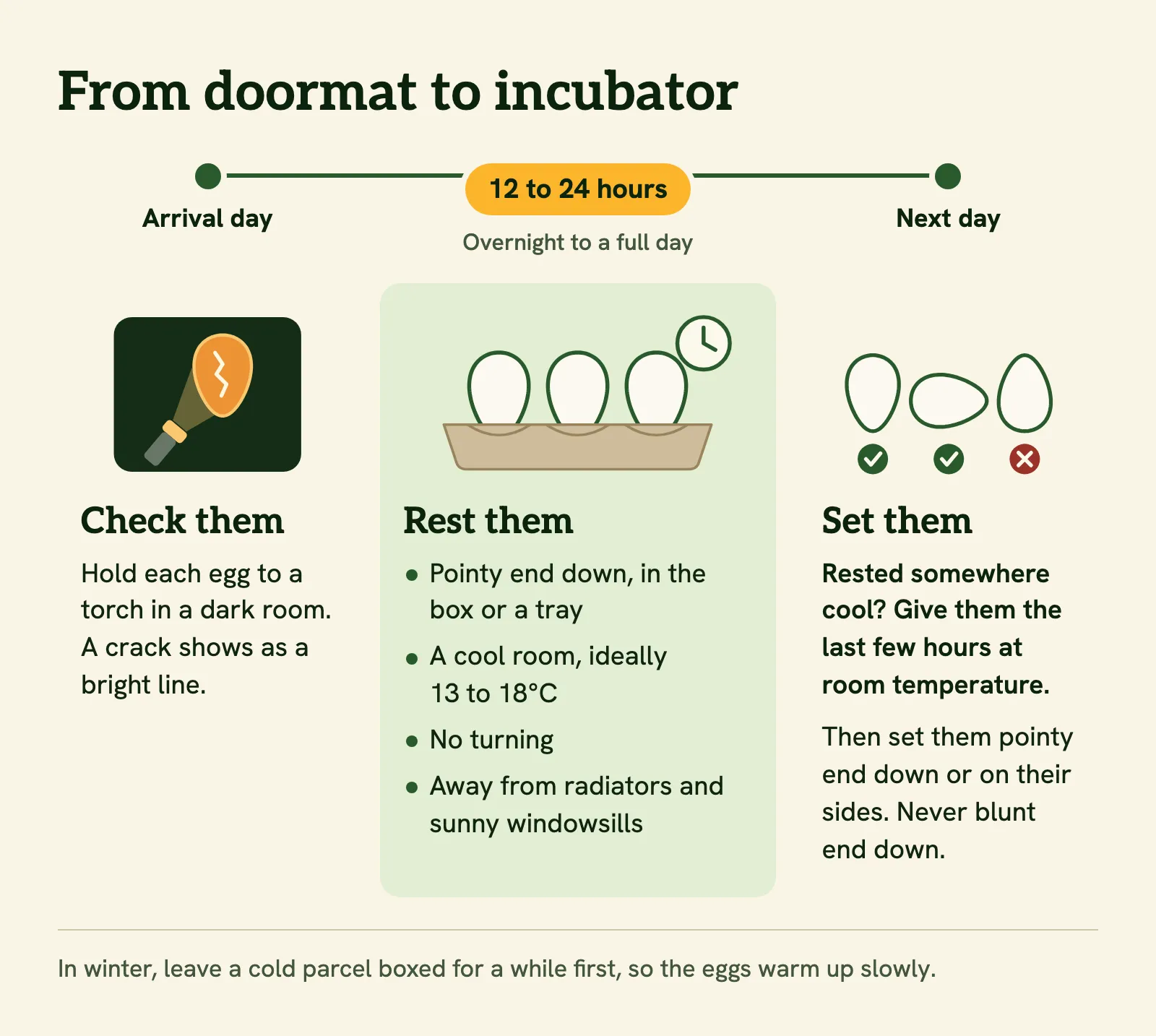
Check them when they arrive. Hold each egg to a torch in a dark room. A crack shows as a bright line, a loose air cell as one that moves, and small bubbles under the air cell can mean a hidden crack, the USDA's graders note. Hairline cracks cut the odds: in one trial they hatched about half the time against three in four for sound eggs, and most guides say not to set them. If you want to try, a 2023 trial brought deliberately cracked eggs back to a normal hatch by sealing them with surgical tape; the repair guide under Arrival day tips on your order page uses a thin coat of PVA glue instead, which a 2000 trial in India also found improved the hatch of cracked eggs. Don't set an egg that has leaked.
Stand them pointy end down in their box or an egg tray, and leave them be. There's no need to turn them for a rest this short: Brinsea suggests daily turning in storage, but Texas A&M, Aviagen and Funk leave it until eggs have waited a week, and Mississippi State four to six days.
Pick a cool room, ideally 13 to 18°C and no warmer than about 20°C, such as a spare bedroom or a hallway. Not the fridge, which Texas A&M calls too cold for fertile eggs, and not by a radiator, on a sunny windowsill or in the airing cupboard: Texas A&M also warns that above about 22°C embryos start to develop abnormally. In a heatwave, use the coolest room you have.
In winter, let a cold parcel warm slowly. Leave the eggs in their box for a while first. A fridge-cold egg can sweat on the kitchen worktop too: at 20°C and 60% humidity, any shell below about 12°C collects water. Eggs chilled close to freezing for a day or two mostly still hatch, Aviagen reports, as long as they're warmed before they're set.
Warm them up, then set them. If they've rested somewhere cool, below about 18°C, move them somewhere at normal room temperature, such as the kitchen, for the last few hours (Texas A&M suggests 4 to 8), so they don't sweat when they go in. Then set them pointy end down or on their sides, never blunt end down, as Durham Hens and Mississippi State's guide also say. When Aviagen's hatchery at Stratford-upon-Avon set eggs the wrong way up, roughly a quarter fewer hatched (22 to 25.5 percentage points).
On arrival day, the free Broody Hatch Planner turns your eggs into a day-by-day plan, with a reminder for each step from setting to hatching.
References
Archer, G. S. and Cartwright, A. L. (2022). Incubating and Hatching Eggs. Texas A&M AgriLife Extension, POSC-PU-018. cdn-de.agrilife.org (PDF)
Armitage, N. (2022). Detached, saddled or tremulous air cells and what to do about them. Cluckin. cluckin.net
Aviagen (2025). Hatchery Tips 2025: Pre-heating eggs (p. 10); Checklist, egg management and setter balance (p. 18); What happens to hatchability when egg stores go through a period of extreme cold? (p. 20); What happens when eggs are set small end up? (p. 22). aviagen.com (PDF)
Barnett, D. M., Kumpula, B. L., Petryk, R. L., Robinson, N. A., Renema, R. A. and Robinson, F. E. (2004). Hatchability and early chick growth potential of broiler breeder eggs with hairline cracks. Journal of Applied Poultry Research 13(1): 65-70. doi:10.1093/japr/13.1.65
Brinsea (2016). Incubation Handbook. brinsea.com (PDF)
Coleman, J. W., Siegel, H. S. and Krause, G. F. (1964). Initial internal temperature changes of incubating eggs. Poultry Science 43(1): 205-208. doi:10.3382/ps.0430205 (reporting Law and Kosin, 1958)
Durham Hens. Guide to hatching fertile eggs. durhamhens.co.uk
East Sussex Smallholders (2024). Hatching posted fertile duck eggs in an incubator. eastsussexsmallholders.co.uk
Flohr, L. B. (1914). Shipping Eggs by Parcel Post. US Department of Agriculture Farmers' Bulletin 594. archive.org
Funk, E. M. (1949). The care of hatching eggs before incubation. In L. W. Taylor (ed.), Fertility and Hatchability of Chicken and Turkey Eggs, pp. 150-177. New York: John Wiley & Sons. archive.org
Gradl, J., Curtis, P. A., Jones, D. R. and Anderson, K. E. (2017). Assessing the impact of egg sweating on Salmonella Enteritidis penetration into shell eggs. Poultry Science 96(7): 2393-2399. doi:10.3382/ps/pex011
Knox, C. W. and Olsen, M. W. (1936). The effect of tremulous air cells upon the hatchability of eggs. Poultry Science 15(4): 345-348. doi:10.3382/ps.0150345. Not read in the original; findings as reported by Funk (1949), p. 167.
Landauer, W. and Baumann, L. (1943). Rumplessness of chicken embryos produced by mechanical shaking of eggs prior to incubation. Journal of Experimental Zoology 93(1): 51-74. doi:10.1002/jez.1400930104. Not read in the original; findings as reported by Funk (1949), p. 167.
Narahari, D., Rajini, R. A., Srinivasan, G. and Ramamurthy, N. (2000). Methods to improve the hatchability of checked chicken eggs. British Poultry Science 41(2): 178-181. doi:10.1080/713654922. Read from the abstract only (closed access).
Perić, L., Mitraković, M., Vekić, M., Đukić Stojčić, M., Žikić, D., Savić, Đ., Meijerhof, R. and Jotanović, S. (2023; online 31 December 2022). Improving the incubation results by sealing the eggshell of cracked hatching eggs with surgical tape. Poultry Science 102(3): 102466. doi:10.1016/j.psj.2022.102466
Reijrink, I. A. M., Berghmans, D., Meijerhof, R., Kemp, B. and van den Brand, H. (2010). Influence of egg storage time and preincubation warming profile on embryonic development, hatchability, and chick quality. Poultry Science 89(6): 1225-1238. doi:10.3382/ps.2009-00182
Shinzato, G., Furuta, K., Higa, H., Tomoyose, R. and Shinjo, A. (1993). Effects of shipping on the hatching results of broiler eggs. Japanese Poultry Science 30(6): 419-423. doi:10.2141/jpsa.30.419
Smith, T. W. Care and Incubation of Hatching Eggs. Mississippi State University Extension. poultry.msstate.edu (PDF)
Torma, T. Á. and Kovácsné, K. G. (2024). Induced and field mechanical effects on the hatchability of broiler breeder hatching eggs. European Poultry Science 88: 1-10. doi:10.1399/eps.2024.397
Tullett, S. (2009). Ross Tech 09/49: Investigating Hatchery Practice. Aviagen. Appendix 5, Some rules of egg storage; Appendix 6, Dew point or condensation table. en.aviagen.com (PDF)
US Department of Agriculture, Agricultural Marketing Service (2000). Egg-Grading Manual. Agricultural Handbook 75. ams.usda.gov (PDF)
Yassin, H., Velthuis, A. G. J., Boerjan, M., van Riel, J. and Huirne, R. B. M. (2008). Field study on broiler eggs hatchability. Poultry Science 87(11): 2408-2417. doi:10.3382/ps.2007-00515
Comments
No comments yet - start the conversation.