Written on 13 November 2026, last updated 26 November 2026. Bird flu rules can change from one day to the next, so before you post or collect any eggs, check your country's government page (linked under each country below) for the latest.
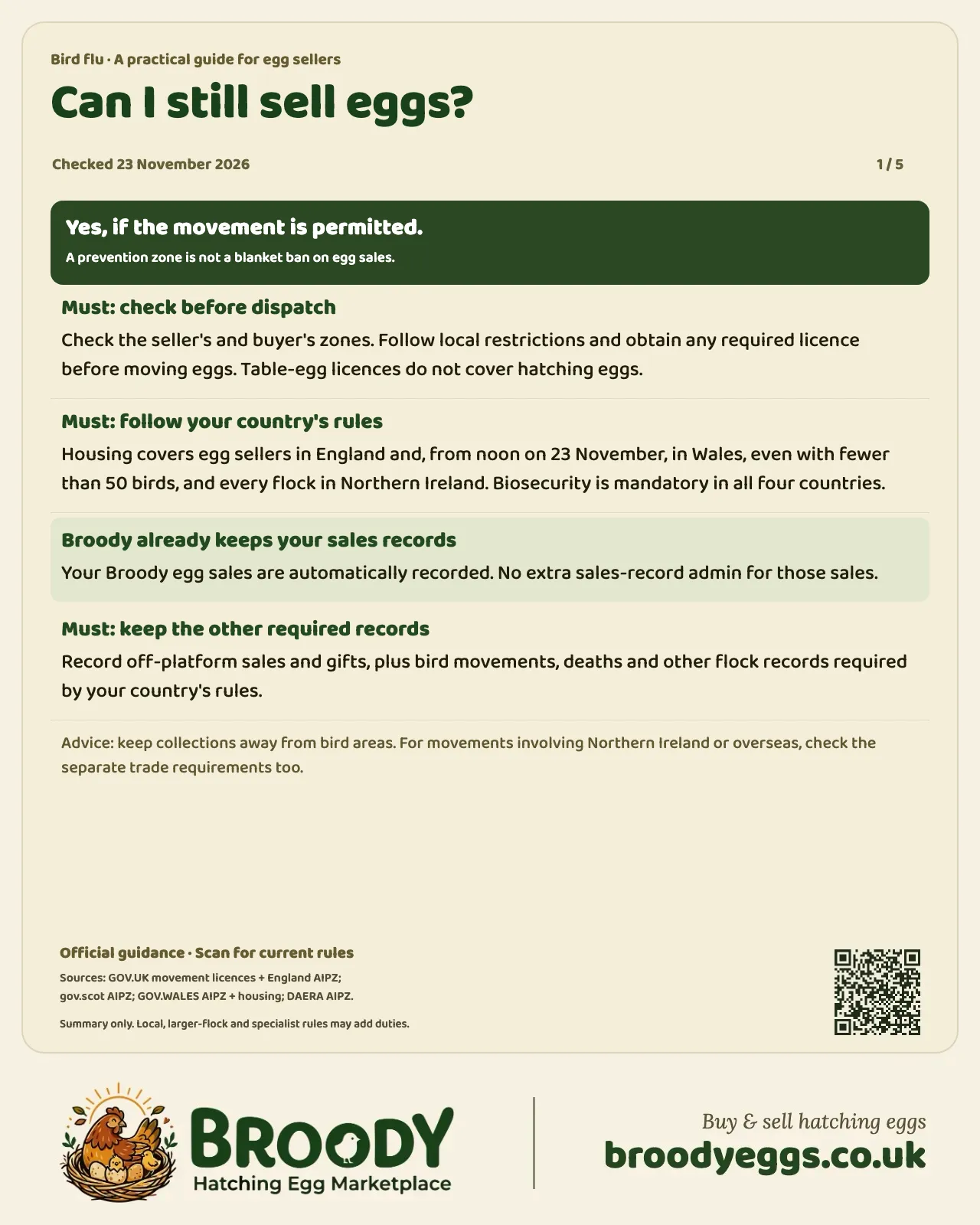
Yes, you can still sell hatching eggs. A bird flu prevention zone isn't a ban on selling eggs. What it changes is how you keep your birds, what you write down, and, if you're inside a disease control zone, whether eggs can leave at all without a licence. Here's what that means for you, country by country, as it stands today.
Update, 23 November 2026: Wales requires housing from noon on Monday 23 November 2026, until further notice. If you sell or give away hatching eggs in Wales, the housing order means your birds must be housed, whatever the size of your flock. See Wales below.
See where bird flu is right now 🗺️
The government keeps a live map of every confirmed outbreak in England, Scotland and Wales, with the protection zone (3km) and surveillance zone (10km) drawn around each one. Put in your postcode to see whether you, or the buyer you're posting to, are inside a zone. New cases are added as they're confirmed, so it's worth a look before every post.
Open the bird flu disease zone map (GOV.UK)
Curious about wild birds near you? There's also a map of bird flu found in wild birds. In Northern Ireland, DAERA lists its zones on its latest situation page.
Before you post any eggs
Check you're not in a disease control zone. Protection zones (3km) and surveillance zones (10km) are drawn around each confirmed case. Put your postcode into the bird flu disease zone map, and check your buyer's too. The map covers England, Scotland and Wales; in Northern Ireland, check DAERA's latest situation page instead. Inside a zone, eggs can't move without a licence, and the general licences are for table eggs, not hatching eggs, so speak to APHA before you post.
Follow your country's rules, below. In England, selling or giving away eggs makes your birds "poultry", so they must be housed however few you keep.
Keep a record of every movement. For eggs sold on Broody, it's done for you: the Egg movements record on your Orders page lists the date, species, variety, number of eggs and where each clutch went, ready to download or print. Eggs you sell or give away anywhere else need writing down too, along with any birds that come and go.
Register your birds. In Great Britain every keeper must register with APHA, even with a handful of hens. In Northern Ireland, register with DAERA.
England
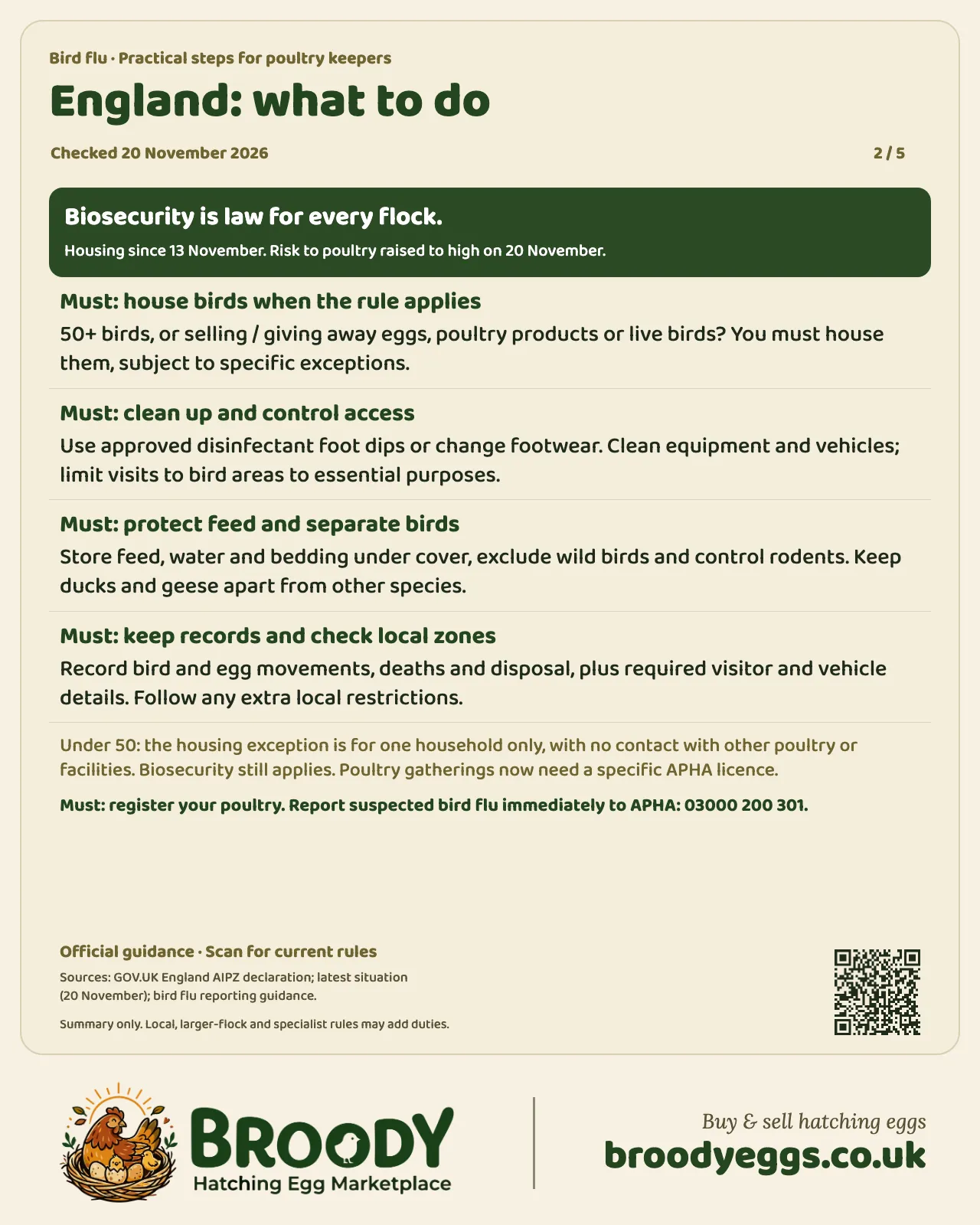
A prevention zone with housing, from 13 November. Biosecurity is the law for every flock, and the zone now includes housing:
50 or more birds: you must house them.
Fewer than 50, and you sell or give away their eggs, meat or birds: you must house them.
Fewer than 50, just for your own household: you don't have to house them, but the biosecurity rules still apply.
That biosecurity means foot dips or a change of boots, clean equipment, feed and water under cover away from wild birds, ducks and geese kept apart from other birds, visits limited to what's essential, and records of bird and egg movements, deaths and visitors. Report a suspected case to APHA on 03000 200 301.
500 birds or more: there are extra rules too. Only essential staff can go into the area where the birds are kept, you must change clothes and footwear going in and out, and any vehicles and equipment going in or out must be cleaned and disinfected.
Update, 20 November 2026: The government has raised the risk of bird flu reaching poultry in Great Britain to high wherever biosecurity is poor, so it's worth going over yours now. The housing rules above haven't changed. In England, poultry gatherings such as shows and live bird sales now need their own licence from APHA, as the general licence has been withdrawn. There are new disease zones in Lincolnshire, North Yorkshire and the East Riding of Yorkshire, so check the map before you post.
Bird flu: latest situation in England (GOV.UK)
Scotland
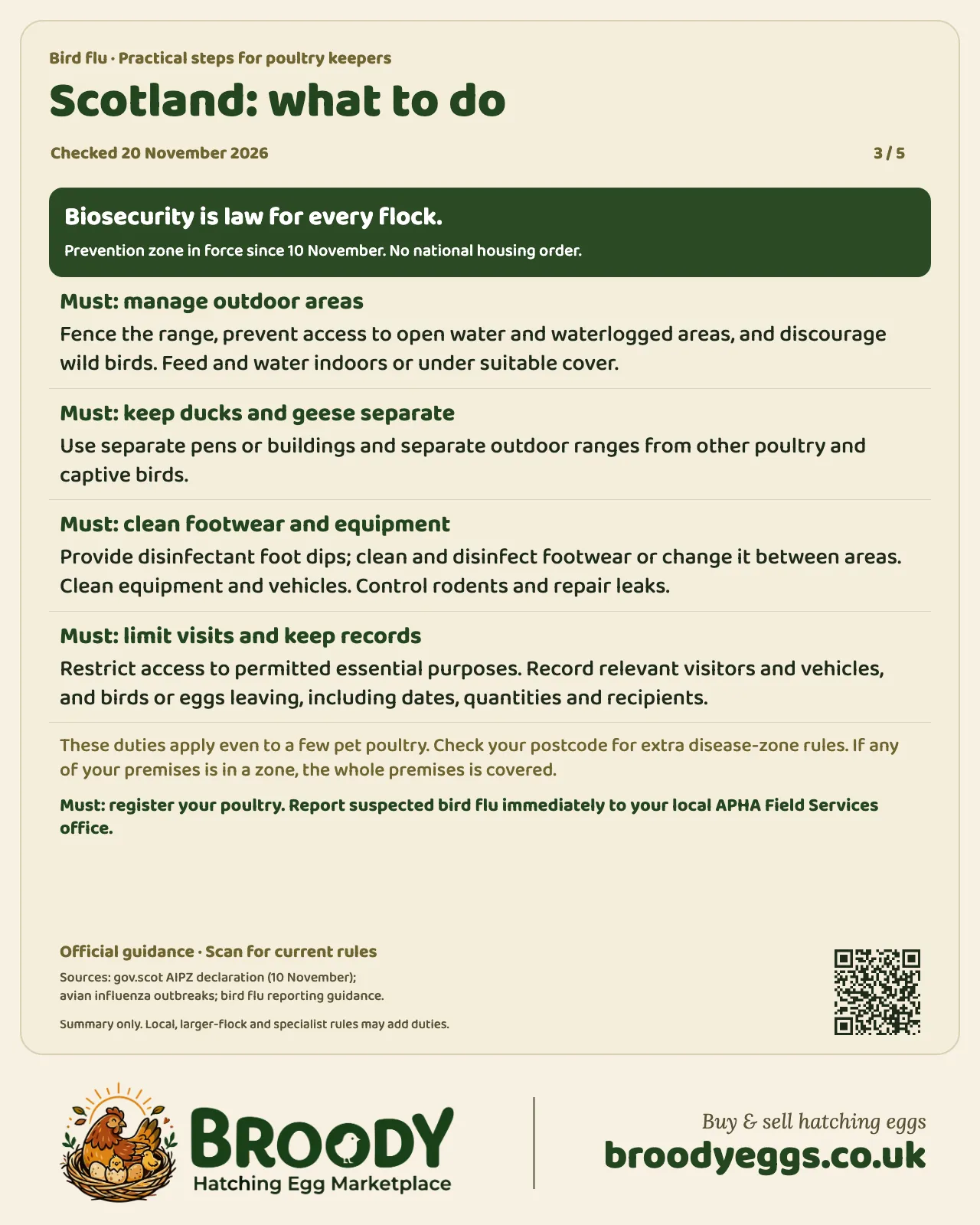
A prevention zone since noon on 10 November, with no housing order. Every keeper, even of a few pet hens, must follow the biosecurity rules: fence the range and keep birds off open water, feed and water under cover, keep ducks and geese separate, clean footwear and equipment, limit visits, and record visitors and any birds or eggs that leave, with the date, how many and who to. Check your postcode for disease zones too: if any part of your premises is in one, the whole premises is. Report a suspected case to your local APHA Field Services office.
Over 500 birds: there are extra rules too. Keep non-essential people off the site, have workers change clothes and footwear before going in with the birds, and clean and disinfect site vehicles regularly.
Avian influenza outbreaks (gov.scot)
Wales
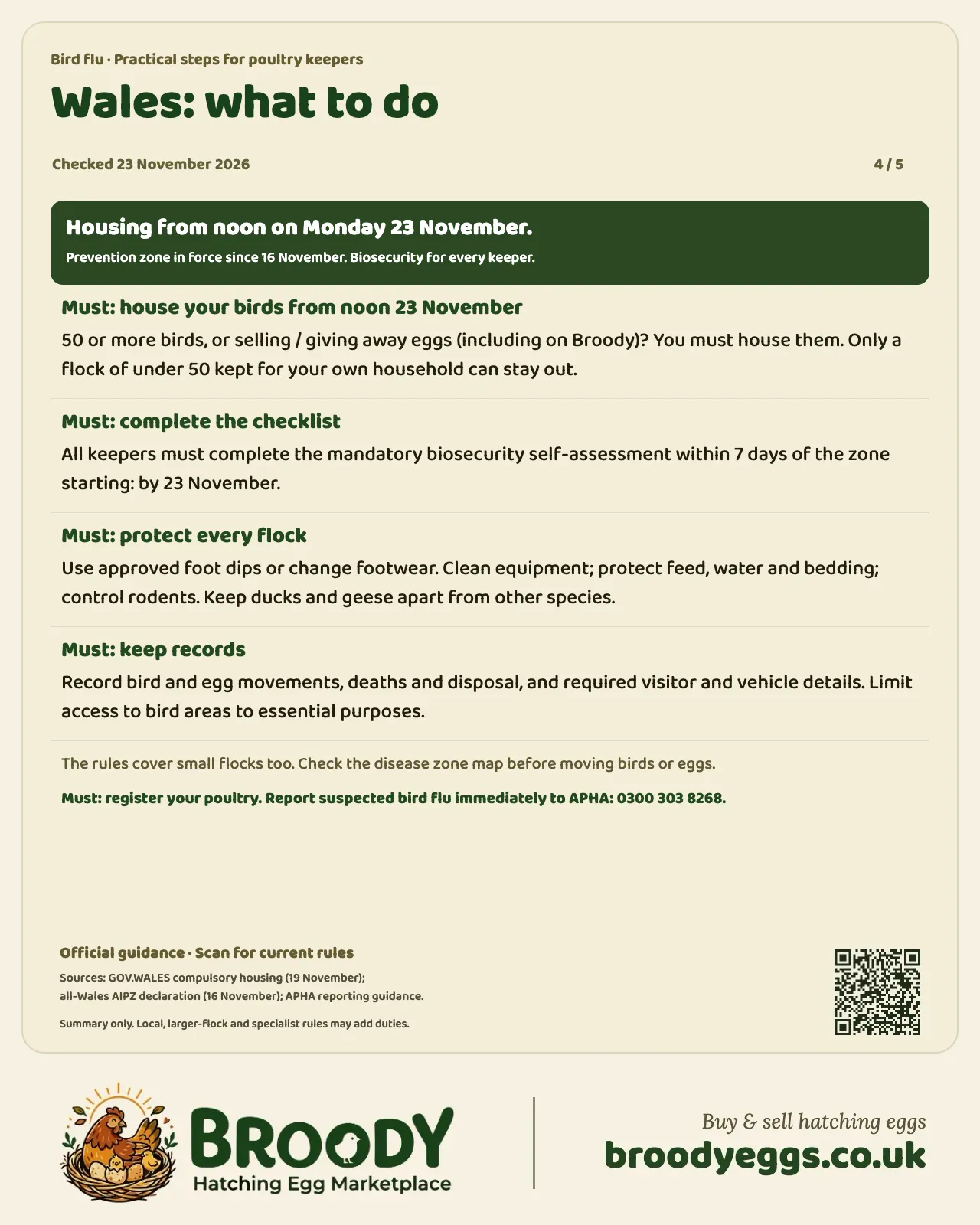
A prevention zone across Wales from noon on Monday 16 November, with no housing order. The housing order isn't in force yet, but it starts at noon on Monday 23 November, so it's worth getting ready now (details in the update below). Update, 23 November 2026: Compulsory housing applies across Wales from noon on Monday 23 November 2026, until further notice; who must house their birds is in the update below. Since 16 November, every keeper, small flocks included, must:
complete the mandatory biosecurity self-assessment checklist within 7 days of the zone starting;
use foot dips or change footwear, clean equipment, keep feed, water and bedding protected, and keep ducks and geese apart from other birds;
keep birds in fenced areas away from standing water, with feed and water under cover;
keep records of bird and egg movements, deaths and disposal.
Update, 21 November 2026: Wales is bringing in compulsory housing from noon on Monday 23 November, until further notice. If you keep 50 or more birds of any kind, you must house them. If you keep fewer than 50 and sell or give away eggs or poultry products, and that includes selling hatching eggs on Broody, you must house them too. It's a good time to check your housing is sound. Compulsory housing measures to protect against avian influenza (GOV.WALES)
Update, 20 November 2026: The prevention zone has been in force across Wales since noon on 16 November, so these rules apply now. If you haven't done the biosecurity self-assessment checklist yet, the 7 days are up on 23 November.
Which checklist? There's one for each size of flock. You don't send it in: fill it in, keep it, and show it to an inspector if asked.
Under 500 birds (most of us): checklist for smaller poultry flocks and other captive birds
500 birds or more: checklist for larger and commercial keepers. Flocks this size also have extra rules, such as a separate live-bird area with restricted access and a change of clothes and footwear going in.
Gamebirds: checklist for keepers of gamebirds
With no housing order, your birds can still go outside at any flock size, as long as they're in a fenced or enclosed area with their feed and water under cover.
Update, 21 November 2026: From noon on 23 November, you must house your birds if you keep 50 or more, or if you sell or give away their eggs, and that includes selling hatching eggs on Broody. Only a flock of fewer than 50 kept just for your own household can still go outside, in a fenced area with feed and water under cover.
There are no disease control zones in Wales today. Update, 21 November 2026: Disease control zones can appear at short notice, so check the bird flu disease zone map before you post. Report a suspected case to APHA on 0300 303 8268.
Update, 26 November 2026: In Wales, poultry gatherings, such as shows and live bird sales, now need their own licence from APHA, as the general licence for poultry gatherings was withdrawn on 25 November. That covers any gathering that includes chickens, turkeys, quail, ducks, geese or other poultry, and you need to apply at least 20 days before the event. Bird gatherings: apply for a specific licence (GOV.WALES)
Avian influenza: current restrictions (GOV.WALES)
Northern Ireland
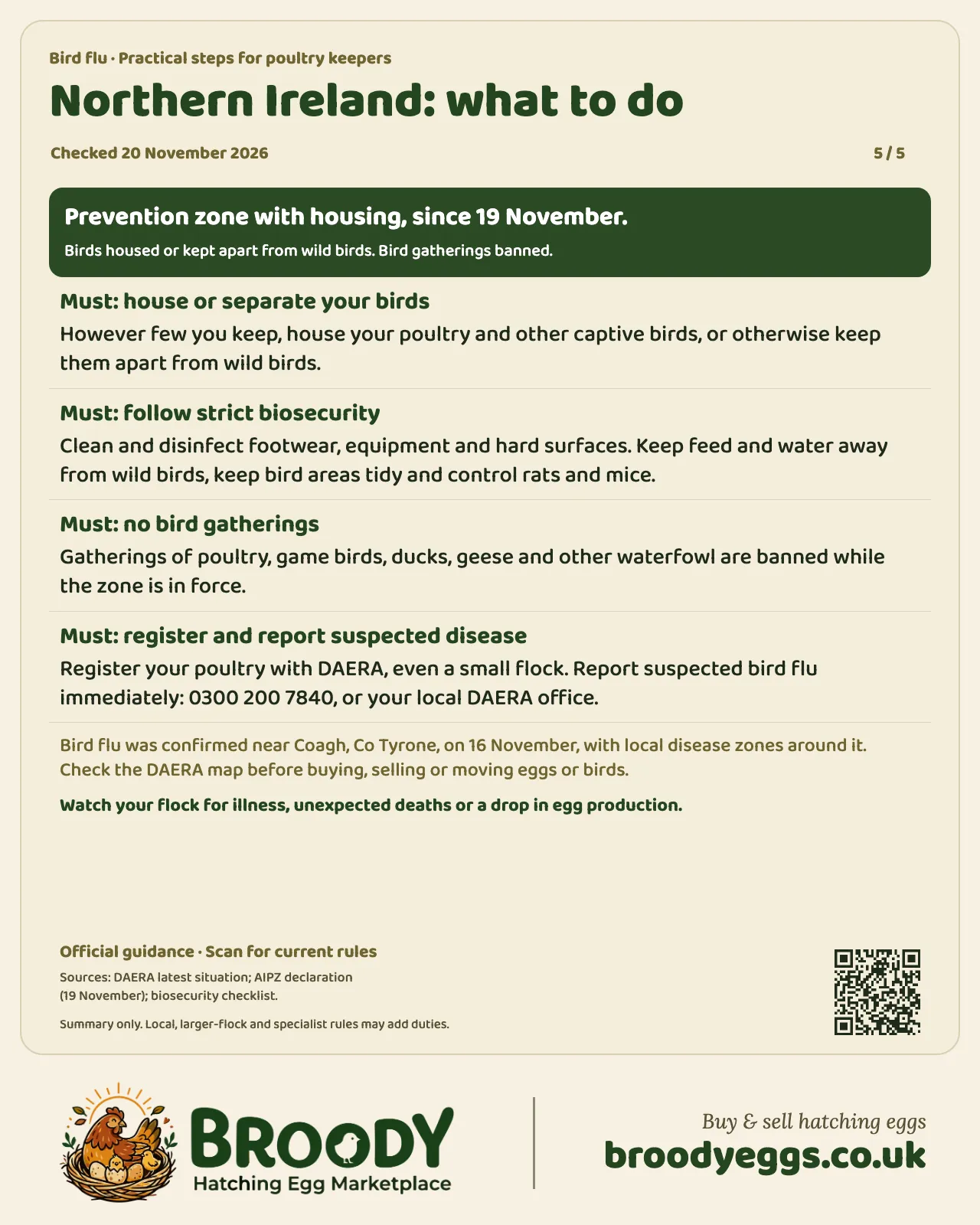
No prevention zone and no housing order. Bird flu was found in a wild swan in Derry / Londonderry on 10 November, the first this season, so DAERA is urging every keeper to tighten their biosecurity now: clean footwear and equipment, feed and water away from wild birds, outdoor runs fenced and away from ponds, ducks and geese kept apart where you can. You must register your birds with DAERA, however few, and report a suspected case straight away on 0300 200 7840. Moving eggs between Northern Ireland and Great Britain has its own trade rules, so check those too.
Update, 17 November 2026: Northern Ireland is bringing in a prevention zone with housing from 00:01 on Thursday 19 November. From then, all poultry and other captive birds must be housed or otherwise kept apart from wild birds, however few you keep, and poultry gatherings are banned. There's a new disease zone in County Tyrone too, so check DAERA's latest situation page before you post.
Update, 20 November 2026: The prevention zone with housing is now in force across Northern Ireland, since 00:01 on 19 November.
Avian influenza: latest situation (DAERA)
Keep an eye on your flock
Whatever the rules where you are, bird flu is a real risk this winter. Watch for birds that seem unwell, sudden deaths, or a drop in laying, and report anything that worries you straight away. And check back: we'll keep the bar on Broody's front page pointing at each government's latest page while the rules are in place.
This is a summary for egg sellers, not legal advice. Local zones, larger flocks and specialist keepers can have extra duties, and the government pages always have the final word.
Comments
No comments yet - start the conversation.